This is the documentation for my 2023 7 Pearls Arts and Sciences competition entry. My intention is to come back and flesh this out more over time to create more of aa easy guide to roman costuming. However I’ve had several requests for this documentation recently in the run up to Pennsic so I figured this was the easiest way to share it.
_________________________________________________________________________________
A Collection of Garments Intended to Represent a Well-To-Do and Highly Placed Man and Woman of the Roman Empire.
-or-
Why Not to Try and Block Print an Entire Wardrobe in One Week Between Pennsic and 7 Pearls With an “Unprecedented” Heat-Dome Parked Over Your House.
An Arts and Sciences Project by The Honorable Lady Rannveig Hrajshvelgsneys Alfvinsdottir
Champion of the Barony of Blackstone Mountain (A&S)
To Be Presented at
7 Pearls
In the Barony of Thescorre


How we got here
In last year I have had the honor to be a part of Their Majesties royal wardrobe team, working alongside some immensely talented craftspeople to produce the outfits worn throughout the reign.
As I am sure you can imagine, Pennsic 50 was a pretty Big Deal, and a lot of work was put forth to create some show-piece outfits for AEthelmearc King and Queen, as hosts of the great war, to shine in.
One of those planned outfits ,which much to my chagrin I was un-able to complete in time to be worn at Pennsic, was a relatively simple set of Roman garb.
The intention was for a set of clothes that Their Majesties could wear for more “dressed-down” occasions. Something easy and comfortable for hot weather, but still regal enough to befit the Crowns of AEthelmearc.
After Pennsic I asked Their Majesties for permission to go-ahead and create the outfits, since there will no doubt be other (very) hot events.
I also wanted to take the opportunity to zhuzh* them up a little more than I would have been able to do pre-Pennsic, both as an apology for not finishing them sooner, and also as a “Thank You!” for letting me be part of Their Wardrobe Team. It has been an experience I will treasure.
Their Majesties were kind enough to allow me to complete these garments as I desired.
Additionally They granted permission for me to showcase the finished garments and documentation before you today, at this 7 Pearls Art & Sciences Competition.
- *zhuzh or zhoosh [ zhoozh ] ,verb (used with object)
- to make (something) more lively and interesting, stylish, or appealing, as by a small change or addition (usually followed by up):These colorful throw pillows are an easy way to zhuzh up your living room. noun
- the act of giving something lively interest, style, or appeal, or the fact of having these qualities: Give your hair a quick zhuzh with a curling iron and mousse. I’ve been told my writing could use a little more zhuzh.
What you see before you

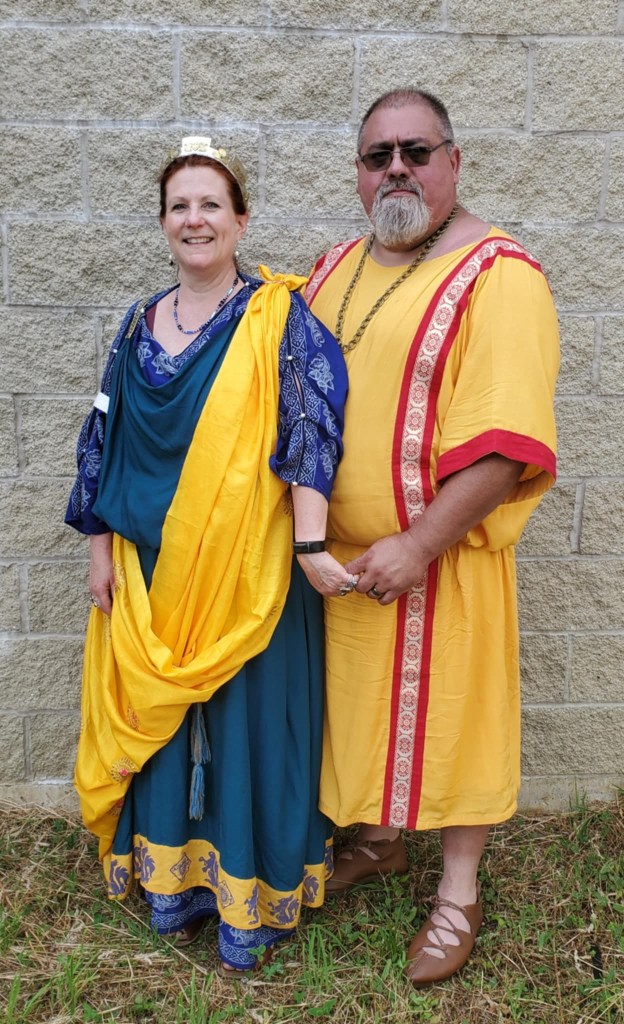
My goal was to create easy to wear outfits appropriate for a high ranking and well respected couple from Ancient Rome, loosely set around the time of the eruption of Mt. Vesuvius, which destroyed Pompeii and Herculaneum in 79CE.
Their Majesties were kind enough to provide me with a selection of lightweight cottons in a variety of Their preferred jewel tones to use for these garments. While finely woven wools or linens would be more likely to be the fabrics used for these garments in period, cotton would not have been unknown to Romans during this time period, as it was cultivated in Egypt during the Roman occupation.
I would like to note here that as I worked with the fabrics I came to suspect that they were not 100% cotton, but perhaps a cotton/rayon blend. I did do a few burn tests, but as cotton and rayon are both plant based, I couldn’t really discern anything more conclusive than I’m confident it’s not wool or polyester.
In regard to the colors used. Linen is difficult to dye, and rarely achieves anything beyond pastel shades. Wool however takes dye beautifully, and would make for brilliantly colored garment. Dyeing fabric was a costly and time consuming process, and as such, dressing in bright saturated colors would be an instant visual marker of wealth and status.
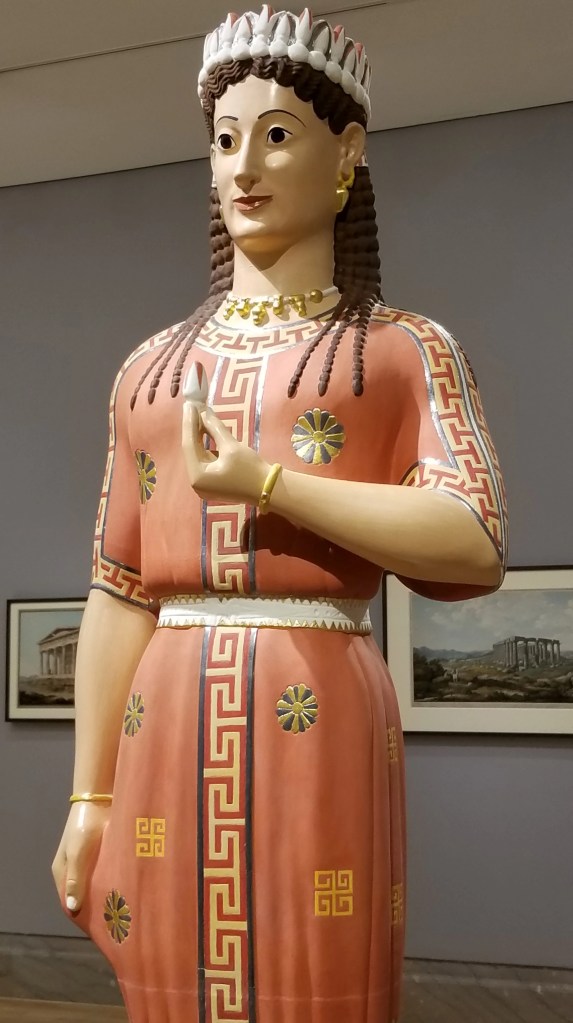
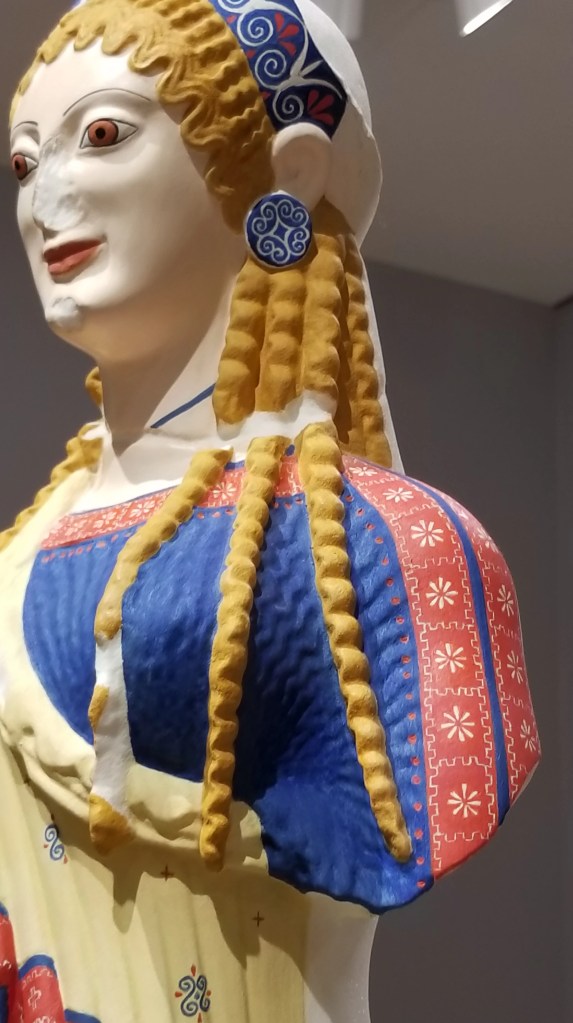
Personally, I was positively gleeful when I saw the colors, as I have long been inspired by the exhibit “Gods in Color: Polychromy in Antiquity”.
This exhibit challenges the popular image of Greek and Roman statuary (and clothing) being devoid of color by taking recreations of surviving statues and painting them in what are believed to be the originals colors before time and weather eroded away there paint.
”WE IMAGINE ANCIENT STATUES AND BUILDINGS AS MARBLE WHITE. WE’VE GROWN COMFORTABLE WITH THIS IMAGE – BUT IT IS INCORRECT.”
Frankfurter Allgemeine Zeitung
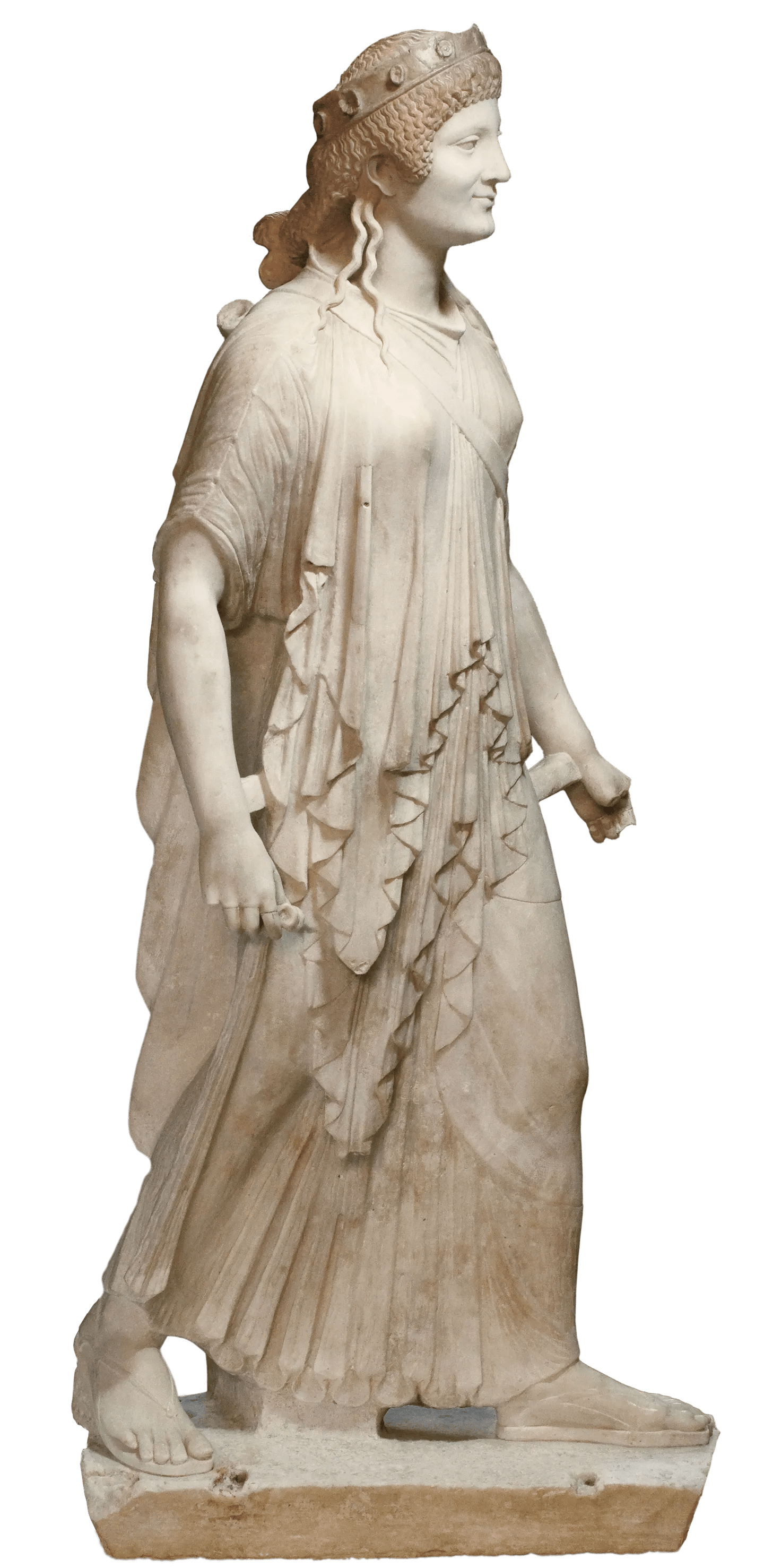
On the following pages are some images from that exhibit that have particularly stuck with me over time.
In particular there is a statue of Artemis, discovered in Pompeii and preserved by the volcanic ash left from the city’s destruction. While representing a goddess, and possibly somewhat allegorical, I could not help but take inspiration from this statue for Her Majesty’s outfit.
“Pompeii, July 19, 1760: a marble statue of the goddess Artemis is unearthed. According to the excavation report, the original polychromy is still clearly visible. The volcanic ash that buried Pompeii due to the eruption of Vesuvius in 79 CE had preserved the pigments.”


His Outfit
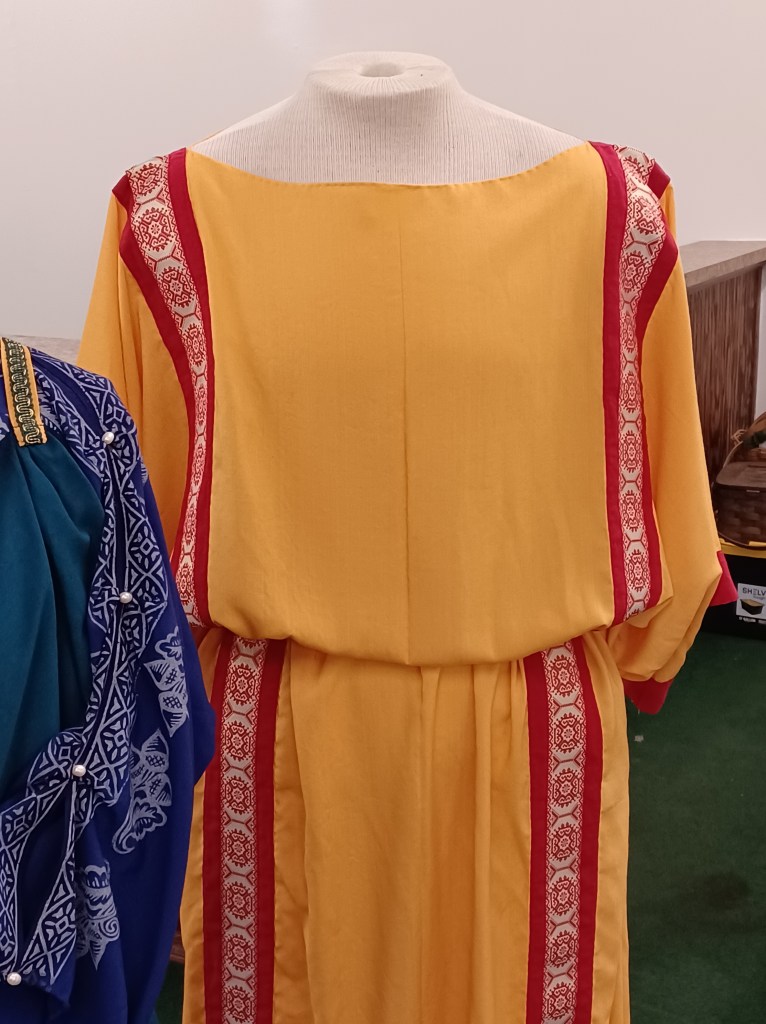
For His Majesty I made a relatively basic sleeved Tunica in a rich saffron yellow and featuring Clavii and sleeve trim in a lightweight red linen. Additionally the Clavii are embellished with a rich woven trim in gold and red.
Tunica
I decided to cut the Tunica to be slightly longer than knee length when belted.
Because His Majesty would be on the move at Pennsic, as well as leading the AEthelmearc army, I wanted this Tunica to have more of a practical military feel than the longer ankle length styles favored by the Roman Senators.
However, I was unsure on His Majesties stance on Pants vs. No Pants. This length is my attempt to keep it just long enough that if he wants to wear shorts, or even full pants and boots under the Tunica, it won’t be too obvious or look out of place.
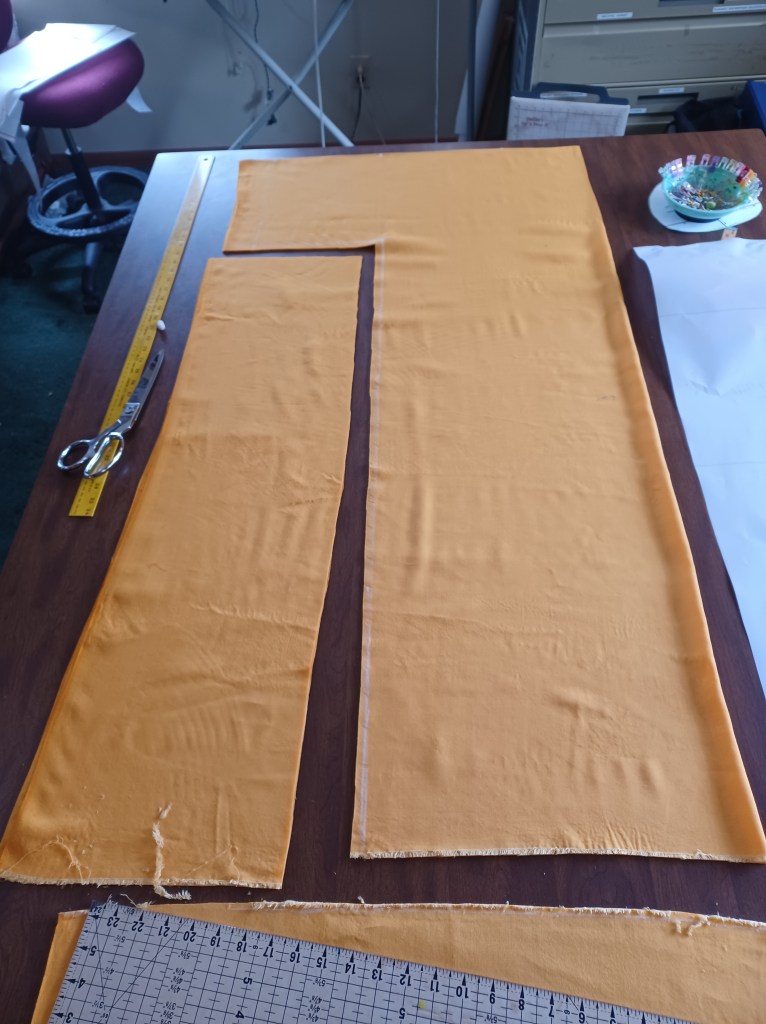
The neckline was at first a simple straight across slash, but I later went back and cut it as more of an oval shape. I believe the shaped neckline will fit His Majesty better and be more comfortable to wear. The neckline is finished with a simple hand rolled hem stitch.
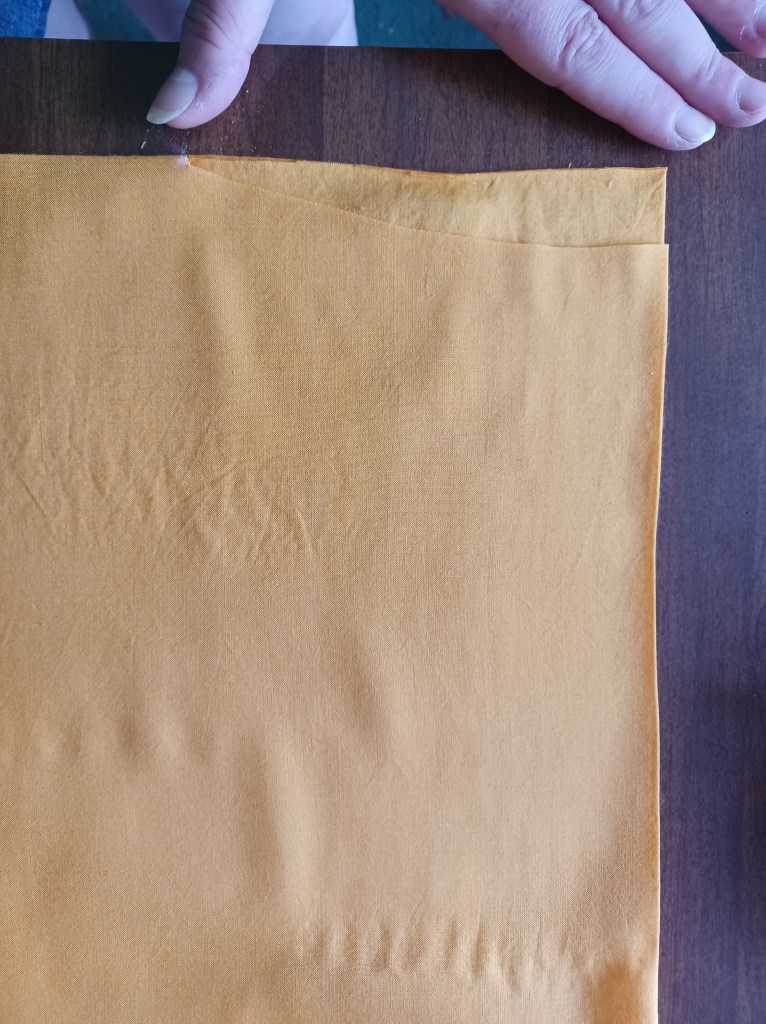
*Mea Culpa time: This is actually the second Tunica I cut. I had cut the first Tunica out and was just about to pin on the Clavii when I thought to double check my measurements. At that point I realized I had cut the Tunica with the same amount of wearing ease we used for His Majesties cotehardies.
This would have resulted in a very snug Tunica and would have lacked the fullness and draping it is meant to have. I debated slashing the yellow fabric of Tunica along the placement lines for the Clavii, and sewing in the Clavii, which would have gave me a few extra inches of ease. However I was concerned that the differing weights of the yellow cotton and the red linen would cause the garment to hang and move in an odd manner.
Ultimately (Luckily!) I had exactly enough yellow cotton left to cut a much more appropriately sized Tunica. This allowed me to go-ahead with applying the linen Clavii to the yellow base fabric as I had intended. *Whew!*
Clavii

The 3 inch wide Clavii were cut from a red lightweight linen and applied to the Tunica using a machine blanket/applique style stich. I considered hand stitching it down, but time was a factor and I’ve used this particular machine stich before with good results and find it to be relatively unobtrusive.
I debated between using red or white for the Clavii, both of which I had on hand.
I thought that the white could look very refreshing and summer appropriate. However, when researching Roman use of colors I found references to white as being, in the same way we might view it today, representative of purity, while red was considered a very masculine color. Additionally, I had just finished for His Majesty a red and gold cotehardie, and I thought the red was very flattering on Him, so I chose to go with the red and yellow color combination over white and yellow.
While most Clavii were plain solid colored bands woven into the fabric or applied onto the fabric, I did find a few mentions of later period Clavii having woven in designs. Never one to miss an opportunity for embellishment, I had originally planned on block printing a border design onto the Clavii, perhaps incorporating either some acorn or squirrel elements to call back to His Majesty’s personal device.
After some test stamping I discovered that none of the border blocks I had really created the effect I had in my mine. Additionally, the gold block printing ink that I had just did not take well on the red linen. I did have an opaque white and a silver ink that took nicely, but they just didn’t work with the already establish red and yellow color scheme.
Impulsively I tossed down a roll of my all-time favorite trim that I had ordered during the height of the lockdowns, and I’ll be darned if it didn’t look just like what I had in my mind!

Ultimately this style of trim is very unlikely to be something they would have used in this manor, but it looked so good, and so regal, that I could not resist.
After pinning said (awesome) trim in place, I stitched it down by hand using a fairly long whip-stich, anchoring it every few inches with a few back-stiches.
The Tunicas sleeves are also trimmed with a narrow facing of red linen. Originally I had planned to stamp these bands to match the Clavii, but after deciding to use the trim I instead chose to leave them plain.
The big glaring omission of a Toga
I made the decision to not include a Toga with this outfit, despite it being the most recognizably Roman garment there is. I had several reasons for this.
- 1: Simple practicality.
This outfit is meant to be a comfortable option for an on the go modern royal with a busy schedule at Pennsic. The Toga, in all its glory, is anything but easy to wear. Even in period the Toga was considered a challenging and cumbersome garment. While it is used to signal high status, I did not feel like it was an appropriate choice for this particular outfit.
Once home from Pennsic I did consider adding a Toga, even if only for display purposes during this 7 Pearls Competition. This brings me to my other reason for omitting a Toga.
- 2: Color Choices.
The only colors I had enough of on hand to cut a Toga from was either the same vibrant blue cotton used in the Queens outfit, or the red linen I used to trim His Tunica.
From everything I’ve read, Togas were somewhat restricted in color, primarily being white or off white, with a red or purple stripe for senators. Additionally darker colors represented death and mourning, while Togas colored entirely purple were reserved for the emperor.
I didn’t want to use the blue, and possibly have it represent sorrow, and while I think a solid red Toga would look super cool, I was just not confident it would be in anyway close to correct.
I decided it was best to let the Tunica stand on its own merits, sans Toga. And at some point should His Majesty desire a Toga , it will an easy addition.

Her Outfit

Tunica
Her outfit begins with a gap-sleeved Tunica in a deep ultramarine blue. The top edge of the Tunica is caught up in small pleats at intervals and stitched with large freshwater pearls, creating the eponymous gap-sleeves.
Additionally the top edge and the hem are embellished with a silver block printed border design that features acorns, referencing elements from Her Majesties personal device.
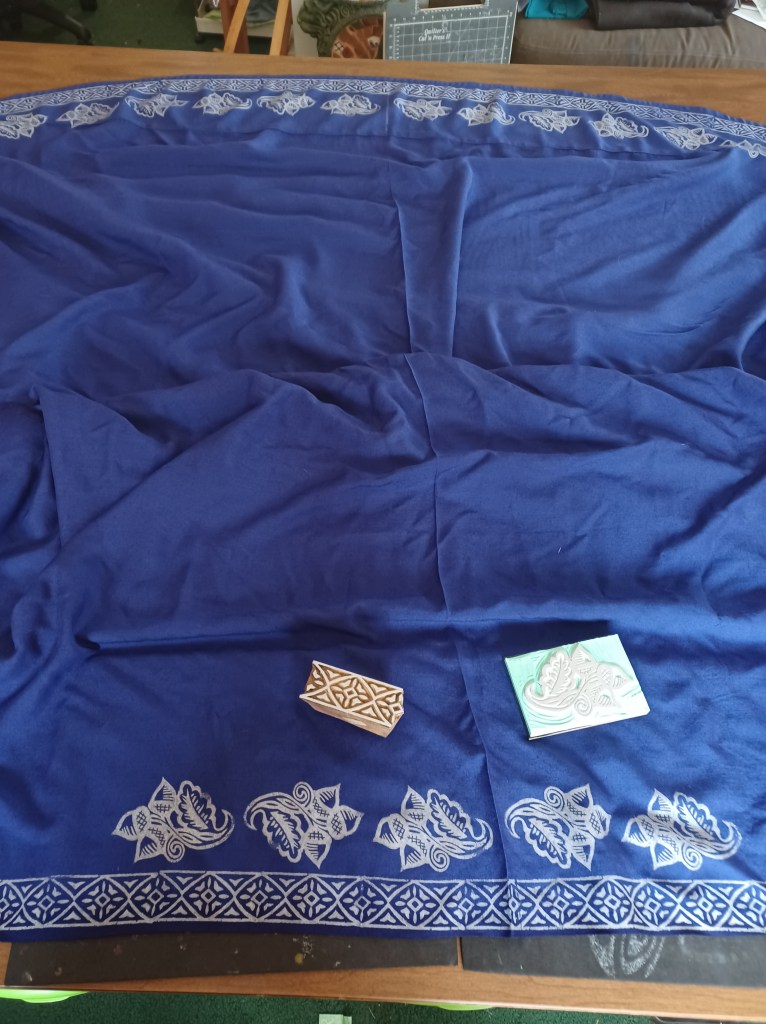
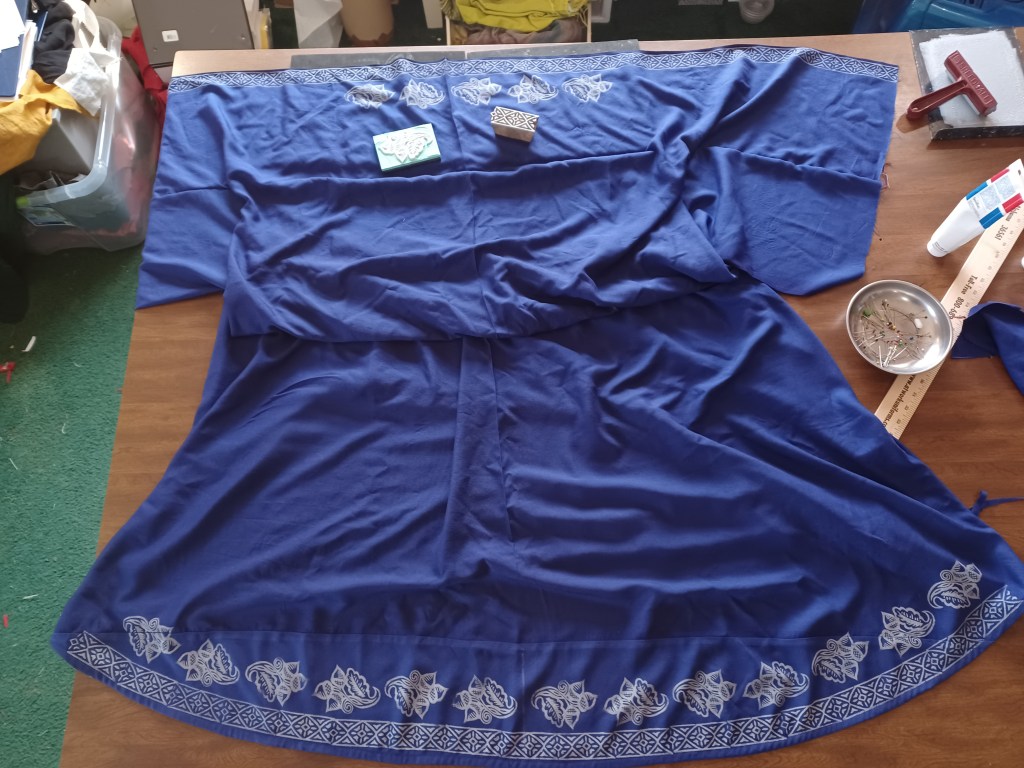
*Note: As you will read in the Palla section below, the weather, and the increased drying time it has caused my block printing inks, has created unexpected hurdles for this project. It took so long for the printed designs to dry, despite doing the printing (in what would typically have been) plenty far enough in advance, that I had to do most the sewing of this Tunica between mid-night and 3am on the morning we started the drive north to this event. And even then the back top edge was still slightly tacky, meaning I had to be extra cautious in my handling of the garment.
Typically, the gap-sleeved Tunica would be made up of a single large piece of fabric, with all the shaping of the garment produced by the pinning and belting of it around the body.
However, for this Tunica, I chose a somewhat anachronistic cut, similar to what is seen closer to the time of the Byzantine Empire.
The garment has been cut along the lines of a basic, but very loose, a-line gown, leaving the top edge entirely open. Additionally, the front panel of the Tunica is cut about 6 inches wider than the back panel. Doing this creates the flattering drape at the front neckline when worn.
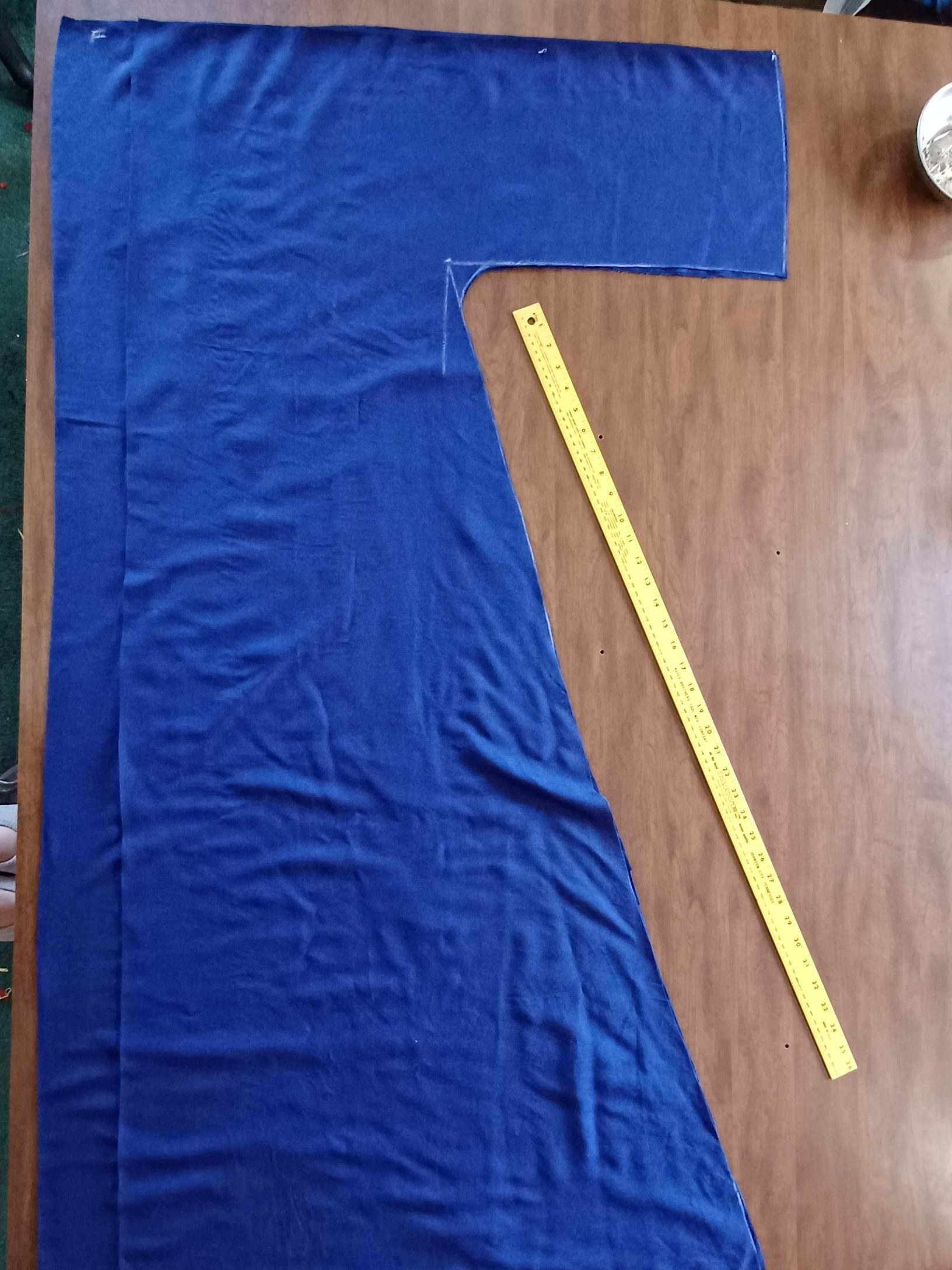
I’ve also rounded the hemline, having it curve up at the side to reduce excess length there when worn. More correct would have been to leave the hem straight across, with excess length managed by blousing the garment over the belt more at the sides.
I have made myself several variations of Tunicas over the years, and have found that these modifications make for a garment that is easier to throw on and easier to walk and move in when busy doing all the odd things we do in SCA and at Pennsic than the more traditional style.
Since the primary goal was for the Queen to have an easy-wear garment, I chose to include these same modifications for her gown.
Stola
Over the Tunica is worn a Stola in peacock teal.
The Stola is traditionally made of what is basically a very large tube of fabric, fastened at the shoulder with either pins on straps. The excessive length of the Stola would then be bloused and managed via belting, creating a voluminous and “bottom heavy” silhouette that immediately signaled a respectable Roman matron.
This garment was really only in fashion during a brief 200 year timespan of Romes vast 1200 year existence. While by 79CE it would have been well on its way out, it was still considered the mark of a truly honorable and noble women. As such, it felt appropriate to include it as a part of this outfit.
However, I did take the liberty of significantly reducing the bulk and length of the Stola, to make a more wearable garment for a modern Queen who has a lot of places to go and things to do.


The Stola features a yellow Institia, or band of trim, at the hem. It is thought this band may have acted as hem guard, similar to what we see on later period European gowns. It would have been easy to remove, wash and/or replace as needed.
I however used it as an excuse for more embellishment, because that’s just how I roll. I added a block printed border featuring little purple squirrels, another reference to Her Majesties personal device and the Queens favors.
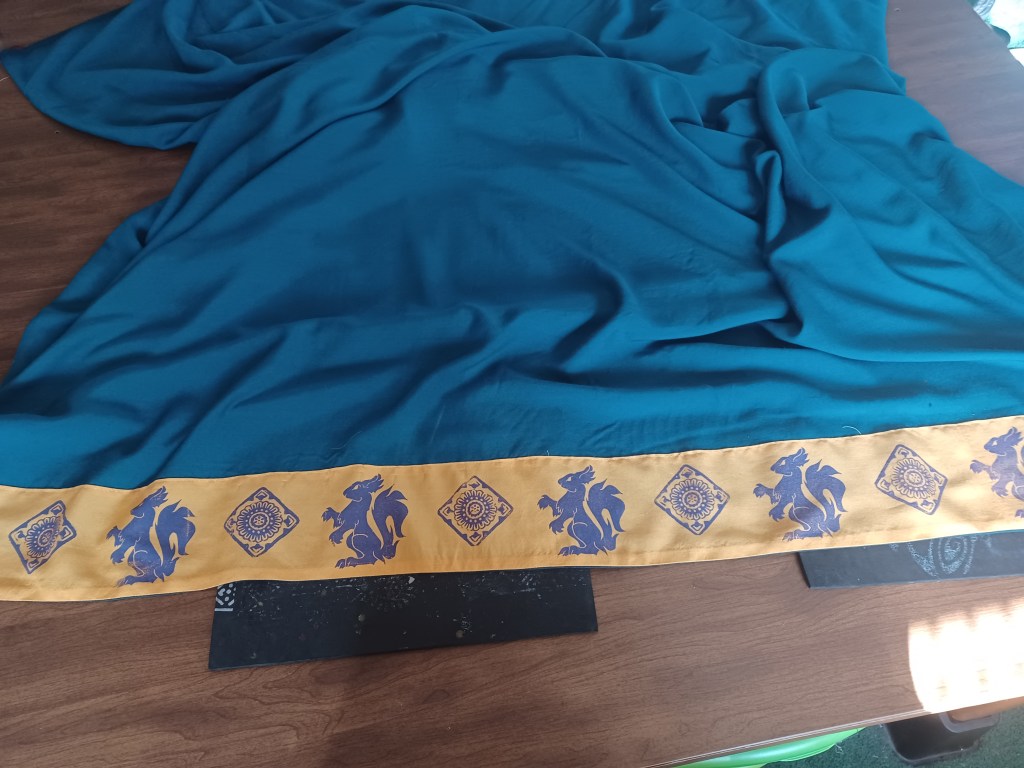
Oddly, the purple ink dried much quicker than the silver did, despite being the same brand and type. I mixed both the silver and the purple inks with a bit of opaque white to tone the colors and help them pop on the fabric. I have to surmise that there is something specific to the silver metallic ink that led to increased drying times.
Palla
Over all *should be* draped a Palla, or shawl, in the same blue cotton as the Tunica, heavily embellished with block printed elements in white, silver and gold, and having small metal acorn charms at the corners to act as weights.
Unfortunately the weather played me dirty at this point.
Over the week prior to competition my area was experiencing a delightful combination of high heat and high humidity that resulted in an even longer drying time for my preferred oil-based block printing inks. These inks already have a typical drying time of several days under ideal circumstances.
While the Queens Palla is cut and hemmed, I finally had the realization that, at the time I was ready to start printing it, there was no chance it would be cured enough to transport and display in time for this competition. Especially since I planned on going pretty heavy with my embellishment.
At that point I made the call to set aside the Palla to complete later, and turn my focus to finishing the primary aspects of Her outfit: the Tunica and the Stola.
Jewelry
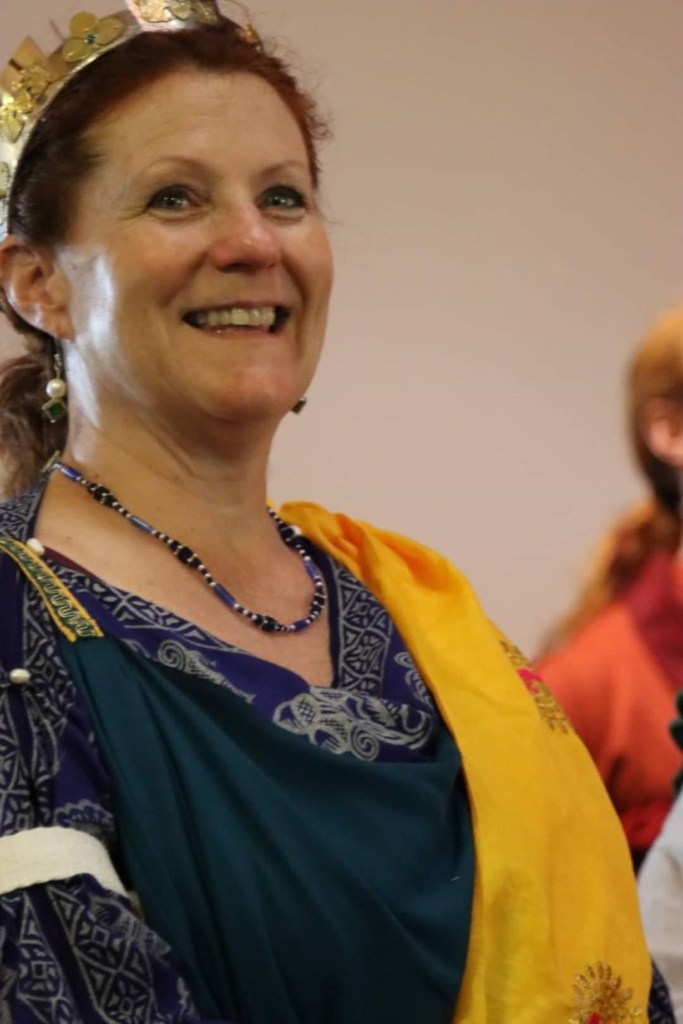
Finally, impulsively, I included a set of acorn and pearl earrings in a style reminiscent of extant Roman pieces, to complete the outfit.

Particularly in women’s fashion throughout Rome’s history, jewelry played a defining role. While historically, most the fabrics used for garments would be relatively un-embellished, the Roman woman would instead embellish and change up her look through the use of jewelry and hairstyling.
In fact, at certain point in Rome’s history woven fabrics had a greater cost than gold, making gold jewelry and accessories a more affordable and changeable style option
Understanding the importance of jewelry in the ancient Roman fashion scene, it seemed like a must to include at least a little bit of bling to go with this outfit.

Kunsthistorisches Museum Vienna, Austria.
“When in Rome….” No really…WHEN??
Rome was around for a really, really long time!
The Roman Empire had an impressively long run, spanning from 8th Century BCE, to 476AD, when the last Roman Emperor Romulus Augustus is defeated by the German Goths, signaling the start of the Dark Ages in Europe.
While Rome experienced a lot of changes throughout its history in the form of lands, border, methods of governing, the clothing stayed surprisingly consistent.
While we see changes in some elements of the fashion, the overall Roman “look” held fast for the entire life of the empire. Roman clothing was a form of cultural identity. By wearing these garments, you were recognized as a citizen of Rome, regardless of background or origin, while to wear other styles would immediately mark you as an outsider.
“Dress for a Roman often, if not primarily, signified rank, status, office, or authority. . . . The dress worn by the participants in an official scene had legal connotations. . . . The hierarchic, symbolic use of dress as a uniform or costume is part of Rome’s legacy to Western civilization.” (Larissa Bonfante. “Introduction.” The World of Roman Costume. Ed. Judith Lynn Sebesta and Larissa Bonfante. University of Wisconsin Press, 1994. Pp. 5-6)
I chose to place these outfits towards the end of the 1st century AD. This was a time when there was some shifting in how certain fashions were worn and by who, which gave me some freedom to use elements and style the garments in ways that best suited my goals.
During this period certain elements that in earlier times had been required, or had very specific meanings, became more of fashion choices that could be worn )or not) by many different peoples.
For example, at one point it was practically required for a woman to wear a Stola outside of the home. There was even an attempt to make it required by law, although it did not pass. However, by the time of Pompeii’s destruction, the Stole was not considered a fashionable garment, with most women eschewing it altogether.
However it still held enough traditional and cultural significance that higher ranking woman, such as the wives of the senators, would still choose to wear it, at least occasionally, to present a very specific and recognizable image of the ideal Roman woman. .
Additionally we see a greater playfulness towards fashion as it became something that was more available and attainable to a border section of classes. This allowed me to have a little bit more fun with my use of color and embellishment choices, as well giving Their Majesties more freedom to wear and style the garments how They desire.
Another example of this is the Clavii, or the two parallel stripes that run vertically across men’s Tunica’s.
Earlier in Rome’s history the use of Clavii was restricted to certain classes of soldier, such as equestrians. Furthermore, specific colors of Clavii were reserved for men of particular statuses, such as purple for senators.
However, later in the empire Clavii become more common across the board on most men’s Tunica’s, becoming more colorful and more of a fashion element than a rank indicator.
The one holdover being that the wider Clavii of up to 3 to 4 inches wide, were still reserved for those men of high status.
Side-Quest: Carving the stamps
I knew early on I wanted to include at least some block printing elements on both outfits, despite it being most likely not a historically accurate method or style of embellishment for these garments.
More accurately, any designs would have been relatively minimal, and would have been woven directly into the cloth.
However, alas, I cannot weave. I can however carve a stamp!
Originally I had planned to pull a few border designs from my existing stamp collection, probably including some escarbuncles into the designs as well. Later, when I realized these garments may not get worn during the Royal Progress, I decided to leave off the escarbuncles, and instead pull in elements from Their Majesties personal devices
And for that what I needed was an acorn stamp! And maybe a squirrel stamp!
*Cut to me, 3 days after Pennsic, impulsively carving an acorn stamp at 9pm while drinking the last of my Pennsic hard cider stash. (Surprisingly, all my fingers are intact!)

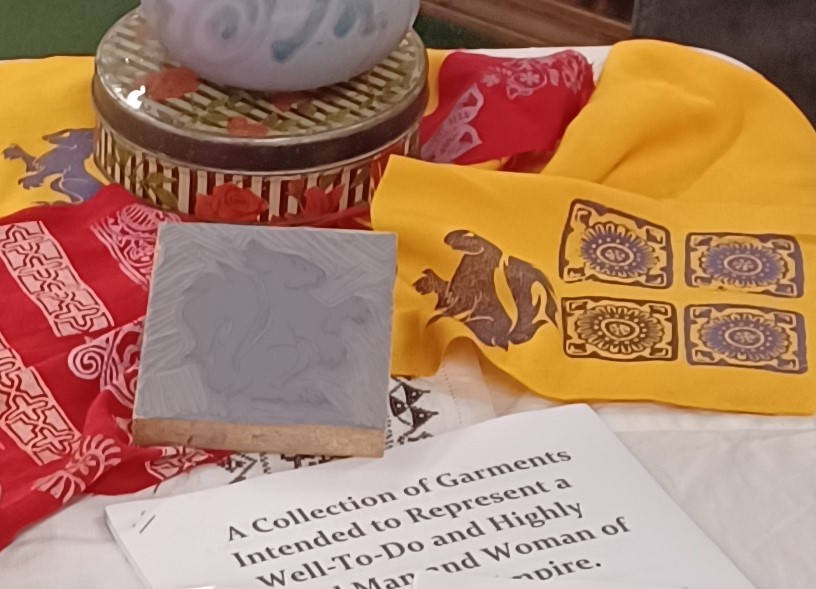
The acorn stamp was carved out of a rubber material and is based off a clipart I saw online and sketched up while squinting at my phone screen. Ultimately, I am pretty happy with this block, and wish I had used a linoleum material instead of the rubber. Linoleum is harder to carve but is sturdier and holds up to extended use longer than the rubber will.

Once I had my acorns, I decided I really did need a squirrel as well. The squirrel is taken directly from Their Majesties heraldry, and this time I did carve it out of linoleum, since my intention is to gift the stamp to Their Majesties along with the outfits, and I want it to be able to hold up to a lot of use.

Sources:
- Gods in Color: Polychromy in Antiquity
The Liebieghuas Skulptuen Sammlung
https://buntegoetter.liebieghaus.de/en/
- Anna’s New Rome Blog is what originally inspired me to start playing with ancient garb, specifically Greek and Roman, and it is still a resource I go back to often.
Anachronistic and Impulsive: A View of Classical Civilization and Byzantium in the Current Middle Ages
Clothing: Ancient Mediterranean
- I leaned heavily on Domina Tullia Saturninas blog “ROMANA SUM”, and particularly her paper “Intro to Roman Clothing”.
This blog is an absolute wealth of (updated!) information and I highly encourage anyone interested in ancient Rome to check it out!
- Women In Antiquity, An Online Resource for Woman in the Ancient World

 Anything I Can Make
I’m glad you found my site helpful! 🙂 Tullia
LikeLiked by 1 person