
This is the documentation for an outfit I entered into an Arts and Sciences competition in March of 2020. The event was The Tournament of the White Hart, and is one of my all time favorite events that I look forward to every year!
White Hart is built around the theme of a classic medieval tournament, in which all the fighters must carry the favor of the one who inspires them. The goal for the combatants is not so much to win, as it is to display honor and chivalry on the field.
This particular White Hart ended up being notable for several reasons beyond just being a highlight of my SCA season. In the A&S competition, I ended up tying for Populace Choice with san amazing seamstress who is always an inspiration and whose level of work I aspire to. In addition to this a dear family friend ( who is like an Aunt) won Judges Choice for her portraiture! But the absolute pinnacle was that we three lost out as overall winners to my daughter, who was named the 2020 White Hart A&S Champion! (something she has not yet let me forget!) I was a proud proud Mama!

Unfortunately, the other notable thing about this particular event was less fun and exciting.
This was actually the last SCA event we had before the pandemic. That morning there had been news of the first positive covid-19 cases out in California, and a few of use were starting to discuss that we might see our kiddos schools shut down for 3 days, maybe even a week, like we had a few months before when the flu hit our area hard.
What no one expected was that three days after this event we would go into full scale lock-down and I wouldn’t go back to work for nearly a year and my kiddo wouldn’t see the inside of her school again for two years.
Pulling the photos to use in this post, it was a little bit surreal remembering how suddenly and drastically the world changed so abruptly after they were taken!
Artisan’s Name: Lady Rannveig Hrajshvelgsneys Alfvinsdottir (Renee Schmutz-Sowards)
Type of Garment/Outfit: My entry is an outfit based on what a middle-class married Rus woman might be wearing in the mid to late 13th century.
The outfit includes the dress, or “rubakha”, over which is worn a “panova”, a type of paneled wrap skirt. The finishing touch is the headwear, made up of an embellished “kiki” or “kokoshnik” worn with a headscarf, forehead band, and an assortment of temple rings.
Based on: The inspiration for this outfit actually came from other researchers and seamstresses work within the SCA and the online historical costuming community. I found their work, and the garments, intriguing and was inspired to create my own garments based off their descriptions.
I found this a particularly interesting project simply because, while I love late period Russian costuming, this particular era and style is not something I’ve ever thought of as that exciting. However, after reading and seeing some other people’s research and enthusiasm for these garments, I felt like I had to try making and wearing them at least once.
Fabrics and Materials: The main body of the rubakha is made up of a natural colored linen embellished with (machine) embroidered stripes. On her webpage “Women’s Clothing in early Rus”, Sofya La Rus states that “Linen ranged from coarse to fine woven. Coarse, homespun wool (sermyaga or seryachini) was used for peasant clothes and also for the undergarments and everyday clothes of the merchant classes, and even boyars. (Kireyeva and Stamerov)” and also that, while Rus clothing was overall very colorful “The raw color of unbleached linen predominated in peasant clothes.”
I chose this fabric because I loved the earthy homespun look of the linen, and I thought the embroidered stripe decoration elevated it in a way that a somewhat well to do woman might choose.

The rubakha (gown) is partially lined with a simple cotton, purely for my comfort (the embroidered stripes are cute, but itchy). It features a facing, cuffs and decorative armbands of purple linen and a machine made woven and metallic trim. I cannot in anyway say the trim is period correct. The truth is I was having a surprisingly hard time finding fabrics and colors that worked well with the striped linen I had already chosen for the body of the dress, so when I noticed this trim worked with it, and that I had just enough of it to use how I wanted, I just went with it.
The panova (skirt) is made up of a woven plaid fabric of unknown content, although I think its 100% cotton, and decorated with a variety of trims. I originally bought a really nice woven striped linen for the panova, however along the way that ended up being used to make a lovely Viking dress for my daughter. I didn’t feel like buying more fabric, so I decided to use whatever I could find in my fabric stash.
I originally started adding trims with the idea that it could mimic a decorative selvage, since I believe these skirts would have originally been made of panels of fabric woven specifically for these garments. However, I ended up using this as an excuse to finally use up some odd bits of trim I’ve had languishing and by the end I just embraced my personal aesthetic of “more is more” and added tassels too.
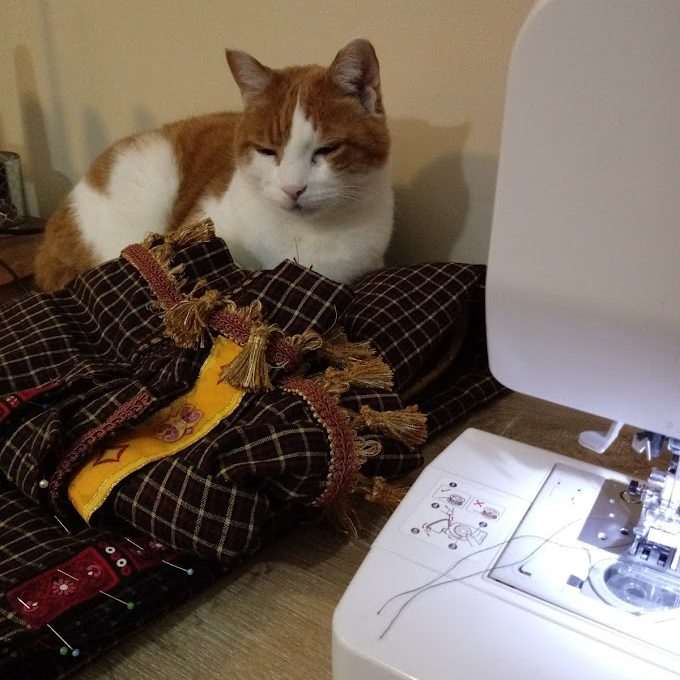
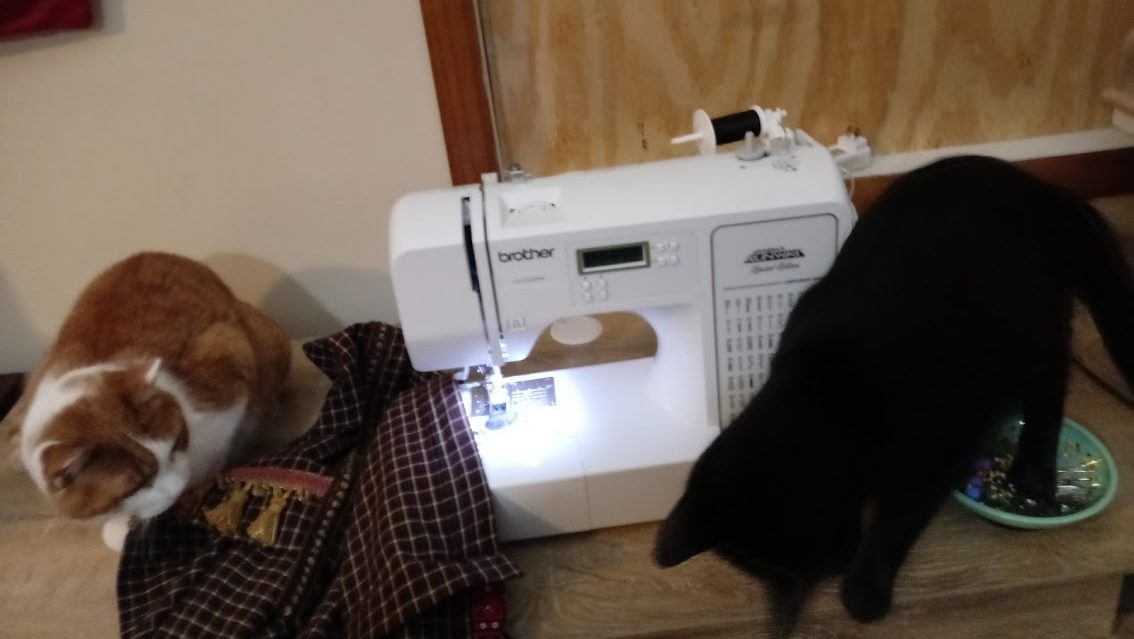
The kiki (headpiece) is made up of a linen outer fabric stiffened with a peltex interfacing that I feel adequately mimics the pliable stiffness of the birch bark that would have been used in period. Since the headpiece was one of the main places to show off wealth and status I decorated it with a woven trims that I feel mimic cloth of gold trims nicely (and affordably) and a selection of artificial pearls.
I also made a few temple rings, using copper wire and glass beads and an old wire coat hanger that I assumed was brass, but turned out to be steel (I DO NOT recommended trying to use steel coat hanger wire for temple rings. Take the time to find brass wire!) For fun I also made a set of temple rings featuring sycamore leaves I salvaged off a brass wall decoration I found at a thrift shop.
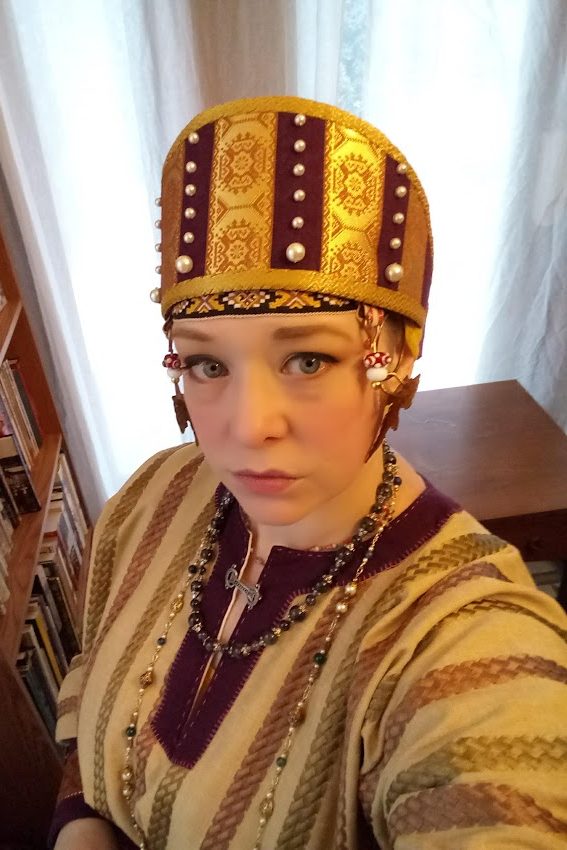
Assembly and Construction: The kiki is largely hand sewn. I applied the gold trim to the linen first, then basted it onto the peltex interface before applying the pearls, stitching through both the interfacing and the linen. I then attached the linen backing and added another type of gold trim around the outside edge, before finishing it by adding the ties that secure it to the head.
The rubakha is machine sewn. I made it by modifying one of my own existing patterns I have been using for years for basic Viking/camp dresses. I made the sleeves much fuller and added wide cuffs. I also cut the neckline closer fitting than I usually wear, since that seemed a common theme for this garment, and more practical for a culture that lives in a colder climate.
I had originally intended to gather the neckline into a very narrow band, which seems to be a common and distinctive feature of the rubakha. However I realized pretty quickly my fabric, especially once it was lined, was too bulky to create pleasing and well done small gathers. So I instead went with a simple narrow facing, embellished with some very basic hand stitching.
The panova is also machine sewn. In my research I came across three main style of panova. The first two consist of three separate panels of fabric suspended from a drawstring at the waist. In one style the panels are completely unattached from each other, and in the other style they are partially sewn together just at the waist and a few inches down.
The third style, which I chose to make, is one piece of material split halfway down the center and worn folded over the drawstring waistband. When worn it gives the appearance of multiple overlapping panels. I chose this style because it made great usage of my fabric, and I also felt like it offered some intriguing options on ways to drape and use the fabric of the skirt when it was worn.
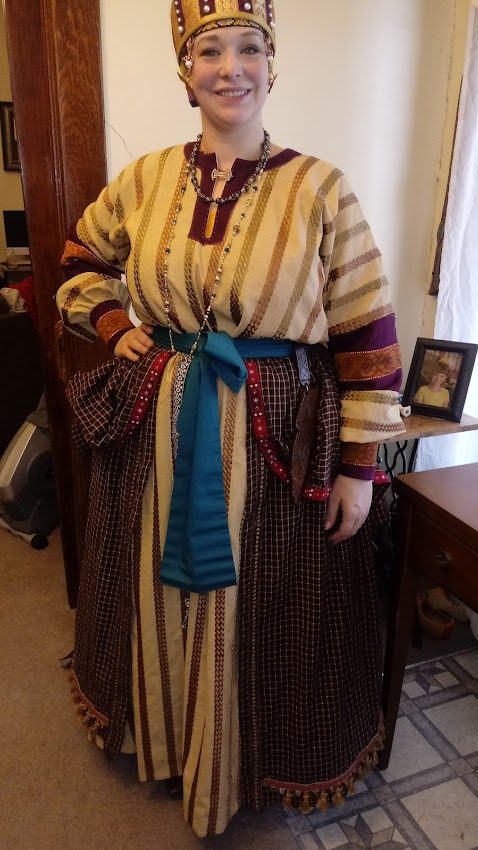
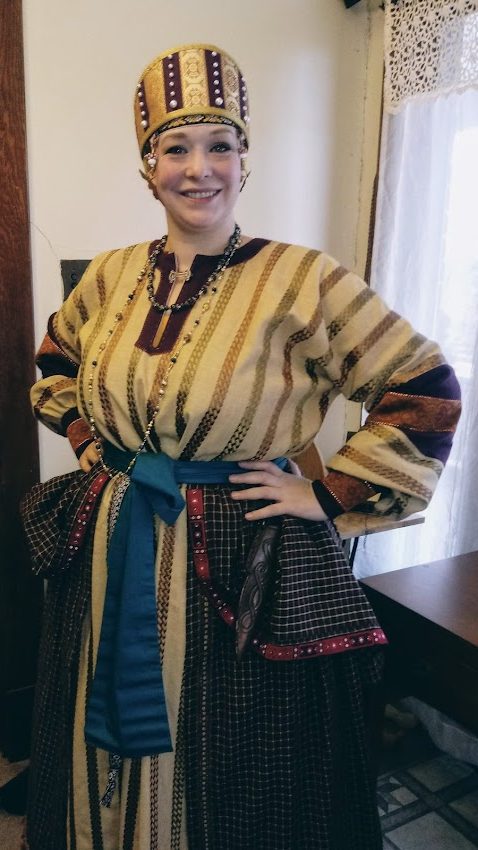
*** Outfit update, several years and a few wears down the road. After a wearing, I’ve realized that the fabric I chose for the dress, while pretty, is way too heavy for this style and would have been better suited for something with a lot more structure…like a couch.
That being said, I am planning a few alterations to make it a little less fussy to wear. I want to shorten the sleeves to take out some of the fullness that ends up falling down over the cuffs and re-shape and shorten the hem. I left too much length at the sides, assuming it would get pulled up when belted. However, the weight and bulk of the fabric really pulls down the dress and actually makes it hard to even cinch in with a belt. I am also considering adding an anachronistic waist-stay tape to help support the weight of the dresses skirt as well.
Ironically, the panovoa, or wrap skirt was the piece that I figured would be a one time wear at most, because it seemed so peculiar and impractical. However, I’ve actually worn it many times and worked in in to some other eras outfits simply because it’s a darn practical garment. It’s easy to wear, accommodates size changes, and if it gets a little cool or rainy I can just pin the split layer up around my shoulders like a shawl and not need to fuss with carrying an extra cloak or wrap.
I am also quite pleased with the kiki, or headpiece, and my sycamore leaf temple-rings. But then, I’m quite pleased with any excuse I have to pile fabric and shiny stuff on my head! 😉

Sources:
“Sofya la rus Medival Russian Life : Women’s clothing in Early Rus” by Sofya la Rus, MKA Lisa Kies, update 7 April 2007 http://sofyalarus.info/Russia/Garb/KWC.html
“Kiev and Me”, an educational blog focusing on Rus and Slav personas by Akilina Ianikitova. http://kievandme.com/ Her general enthusiasm and gung-ho attitude towards making things was a big part of my initial decision to just throw down some fabric and start making a Rus outfit. In addition to general outfit inspiration and research I specifically followed her tutorial on making temple rings from wire coat hangers. http://kievandme.com/how-to-easy-krivitchian-temple-rings-out-of-a-wire-hanger/
“Costume of Ukraine” by N.M. Kamincka, S.I. Nikylenko I could not actually read this book because it was in another language, however I was able to reference several images in it for ideas on how to cut and style my panova.


Akilina is my Laurel! I got really excited lol. your outfit looks great!
LikeLiked by 1 person
Thank you! 😁
LikeLike