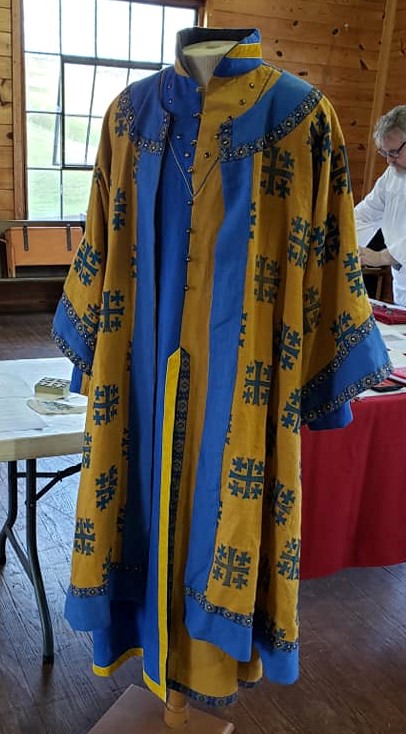
This is the documentation for a men’s outfit loosely based on art from the 13th century . This outfit was originally made as part of a custom clothing order for an excellent young man I’ve had the pleasure of knowing for years and years. He did the best thing an artist can ask for, and gave me ideas on colors and his heraldry, and largely let me go from there.
I went all in and just had a good time, indulging in my love for blockprinting, part-color, trims and metal studs ( Applied using my vintage 90’s Bedazzler!)
After I finished the outfit, I was so darn pleased with the outcome, and eager to show it off, that I begged a boon of him to allow me to enter it in the Arts and Sciences competition at that years Blackstone Raids before I even delivered it to him. This is still probably one of my favorite makes, despite of the anachronisms!
Artisan’s names: Lady Rannveig Hraejshvelgsneys Alfvinsdottir (Renee Schmutz-Sowards)
Type of garment:
Men’s late 13th century inspired tunic and heraldic coat, featuring an all-over block printed design.
Based on:
The tunic was inspired by images commonly found in illuminated manuscripts throughout the mid to late 1200’s and carrying through the early 1300s. I’ve includes some specific examples below.
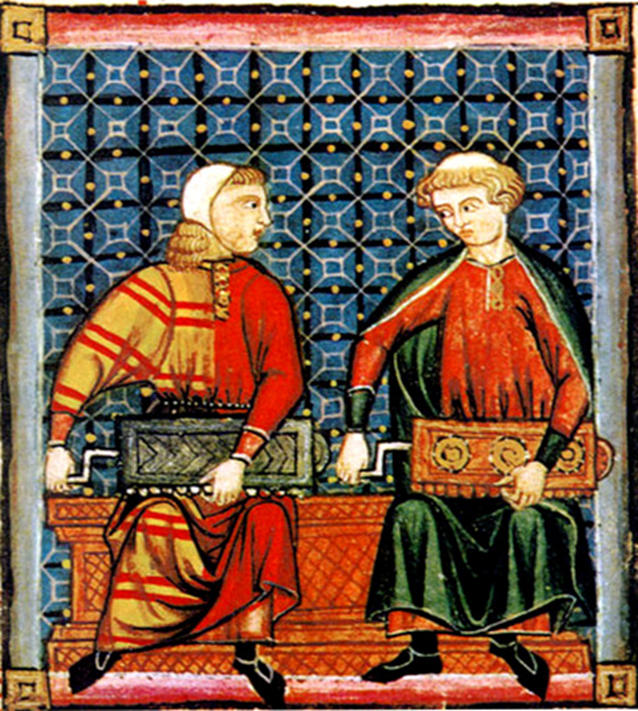
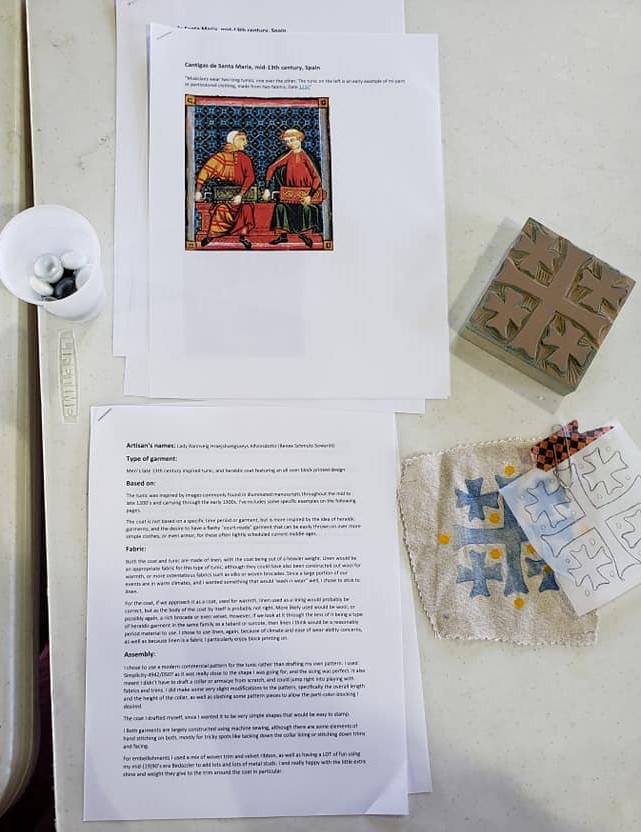
“Musicians wear two long tunics, one over the other. The tunic on the left is an early example of mi-parti or particolored clothing, made from two fabrics. Date 1250”
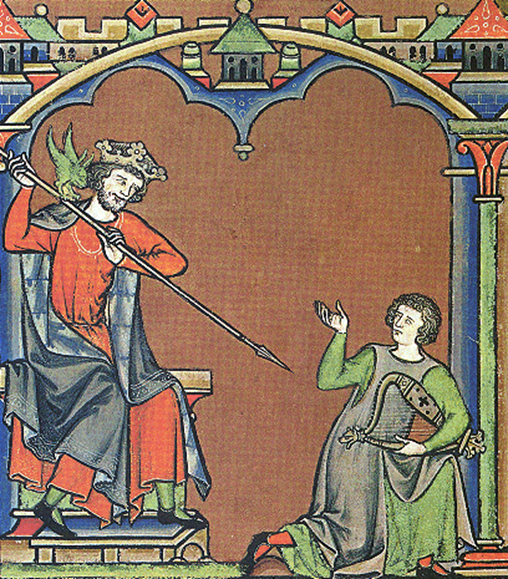
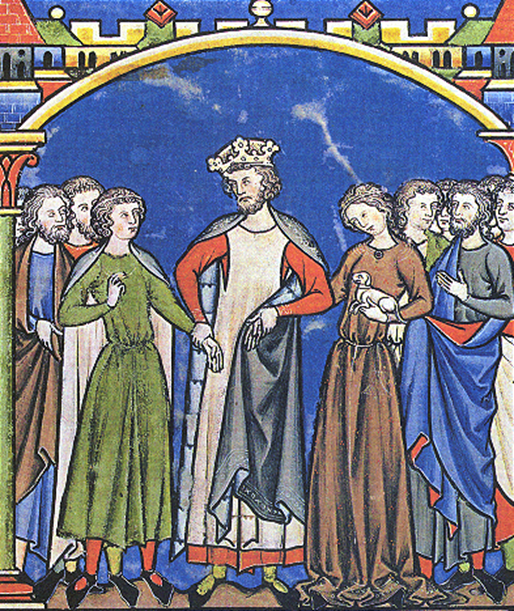
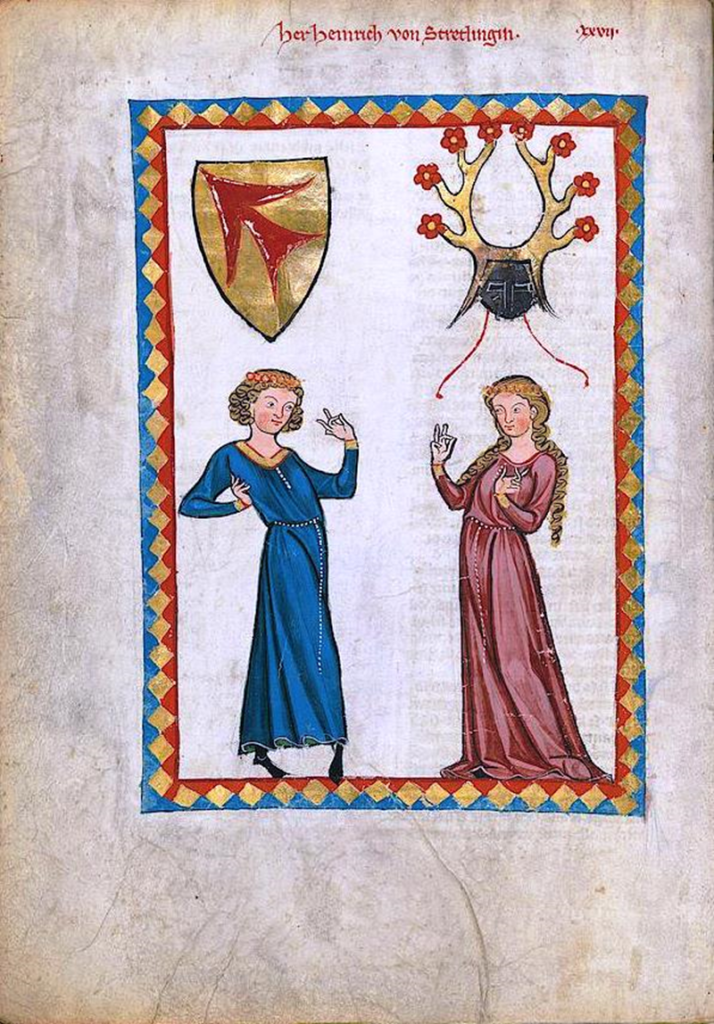
“Illustrated between c. 1304 when the main part was completed, and c. 1340 with the addenda”
The coat is not based on a specific time period or garment, but is more inspired by the idea of heraldic garments, and the desire to have a flashy “court-ready” garment that can be easily thrown on over more simple clothes, or even armor, for these often tightly scheduled current middle-ages.
Fabric:
Both the coat and tunic are made of linen, with the coat being out of a heavier weight. Linen would be an appropriate fabric for this type of tunic, although they could have also been constructed out wool for warmth, or more ostentatious fabrics such as silks or woven brocades. Since a large portion of our events are in warm climates, and I wanted something that would ‘wash-n-wear” well, I chose to stick to linen.
For the coat, if we approach it as a coat, used for warmth, linen used as a lining would probably be correct, but as the body of the coat by itself is probably not right. More likely used would be wool, or possibly again, a rich brocade or even velvet. However, if we look at it through the lens of it being a type of heraldic garment in the same family as a tabard or surcote, then linen I think would be a reasonably period material to use. I chose to use linen, again, because of climate and ease of wear-ability concerns, as well as because linen is a fabric I particularly enjoy block printing on.
Assembly:
I chose to use a modern commercial pattern for the tunic rather than drafting my own pattern. I used Simplicity 4942/0507 as it was really close to the shape I was going for, and the sizing was perfect. It also meant I didn’t have to draft a collar or armscye from scratch, and could jump right into playing with fabrics and trims. I did make some very slight modifications to the pattern, specifically the overall length and the height of the collar, as well as slashing some pattern pieces to allow the parti-color-blocking I desired.
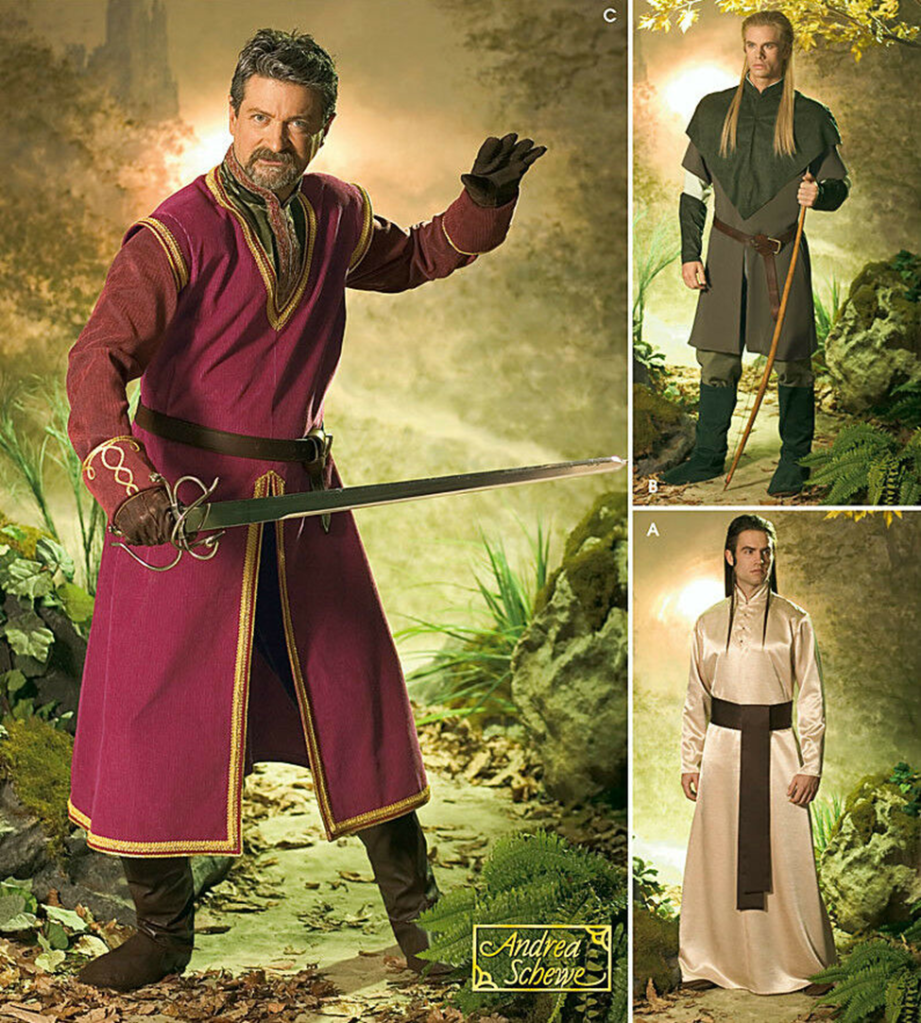
Out of print, but currently available as a print-on-demand through the Simplicity web-site.
The coat I drafted myself, since I wanted it to be very simple shapes that would be easy to stamp.
Both garments are largely constructed using machine sewing, although there are some elements of hand stitching on both, mostly for tricky spots like tacking down the collar lining or stitching down trims and facing.
For embellishments I used a mix of woven trim and velvet ribbon, as well as having a LOT of fun using my mid-(19)90’s era Bedazzler to add lots and lots of metal studs. I am really happy with the little extra shine and weight they give to the trim around the coat in particular.
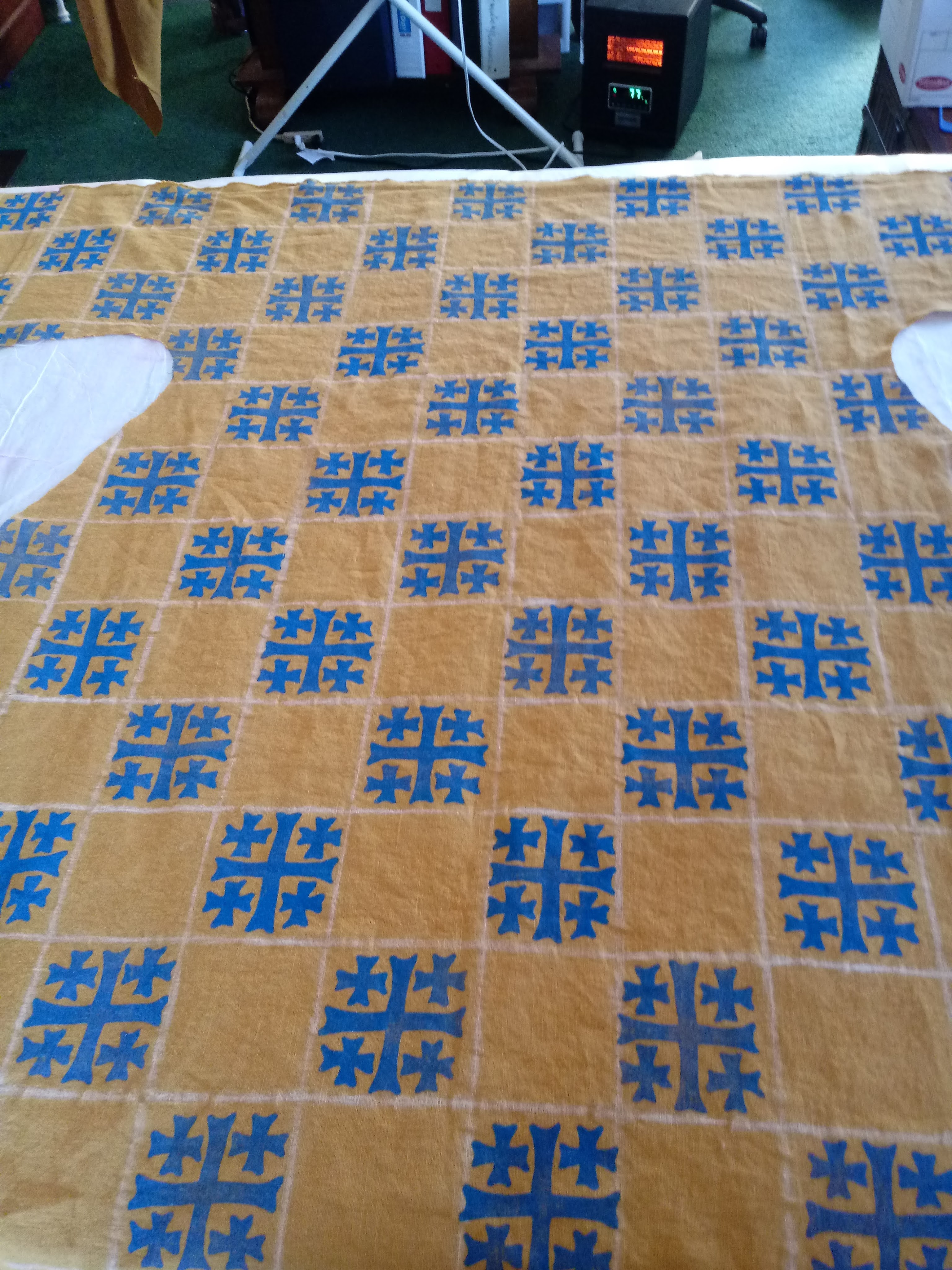
The most striking embellishment is the all-over block print design on the body of the coat. While I’ve used block-print before as an element of surface embellishment, this was my first time doing such a large all-over print.
I carved the stamp using modern Speedball brand lino-block for stamp carving. Unfortunately my hands aren’t up for carving woods, so the majority of my stamps are carved in lino or rubber.
The design for the stamp came from an online collection of free to use orthodox art. I knew I wanted a Jerusalem or crusader cross for this project, since that fit with the wearer heraldry, but I want to avoid anything to modern, or that might be confused with any symbols currently being appropriated by some hate-groups. I really liked how this version of the Jerusalem cross had a softer look, and feel that it translated into the carved stamp and the printed design really well.
The design was printed using Speedball brand fabric block printing ink. I’ve used some other mediums off and on, but this oil-based ink is well pigmented, prints well, stays pretty soft and supple once it dries, and is easy to clean up. (It does take a fairly long time to dry completely though.)
Sources:
- Orthodox Arts Journal, Orthodox illustration Project, Andrew Gould:
- Codex Manesse, Heidelberg University Library, Germany https://doi.org/10.11588/diglit.2222
“Illustrated between c. 1304 when the main part was completed, and c. 1340 with the addenda”, the Codex Manesse is housed at the Heidelberg University Library in Germany. The above citation link address takes you the manuscripts page on the university libraries site, where you can virtually browse through the whole book. It’s awesome!
- Morgan bible circa 1240s, Morgan Library and Museum New York NY https://www.themorgan.org/collection/Crusader-Bible
- “Cantigas de Santa Maria (“Canticles of Holy Mary”) are 420 poems with musical notation, written in the medieval Galician-Portuguese language during the reign of Alfonso X of Castile El Sabio (1221–1284)”
“The Cantigas are preserved in four manuscripts:”
- To (códice de Toledo, Biblioteca Nacional de España, MS 10069, http://bdh-rd.bne.es/viewer.vm?id=0000018650 )
- T (códice rico, Biblioteca de El Escorial, MS T.I.1, https://rbdigital.realbiblioteca.es/s/rbme/item/11337#?c=&m=&s=&cv=&xywh=-1047%2C-313%2C5837%2C6240 )
- F (códice de Florencia, Florence, Biblioteca Nazionale, MS b.r. 20, https://archive.org/details/b.-r.-20/page/n60/mode/thumb )
- E (códice de los músicos, Biblioteca de El Escorial MS B.I.2, https://rbdigital.realbiblioteca.es/s/rbme/item/11338#?c=&m=&s=&cv=&xywh=-711%2C-246%2C4600%2C4917 )
Wikipedia, very helpful in tracking down where these manuscripts are currently housed. https://en.wikipedia.org/

 Anything I Can Make